As we move through the second quarter of 2026, the academic environment in Sydney has reached a point of unprecedented intensity. For students enrolled at prestigious institutions such as the University of Sydney, UNSW, and UTS, the “Emerald City” offers world-class opportunities paired with equally significant challenges. The convergence of a tightening labour market, the rapid integration of Generative AI into core curricula, and the persistent rise in the cost of living has transformed the Australian tertiary experience into a high-stakes endurance test.
The Australian Bureau of Statistics (ABS) recently indicated that the Consumer Price Index (CPI) for education-related expenses in New South Wales has outpaced the national average by 1.4%. For an international student or even a domestic student living away from home, this translates to a razor-thin margin for error. In this environment, the demand for localized support systems is no longer a luxury but a strategic necessity. Whether it is adjusting to the nuanced grading rubrics of local faculties or managing dense workloads, many scholars find that securing professional assignment help Sydney is the most viable path to maintaining their mental well-being and academic integrity simultaneously.
This localized approach is vital because Sydney’s academic standards are unique. Unlike other global education hubs, the Australian system places a heavy emphasis on “Critical Analysis” and “Industry Application.” It is not enough to simply memorize theory; students are expected to demonstrate how that theory applies to the 2026 Australian economic context. This shift has placed immense pressure on students to perform at a professional level while still in the learning phase.
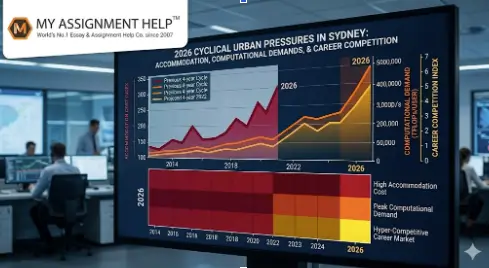
Data Insights: The 2026 Sydney Student Pressure Matrix
To understand the 2026 landscape, we must look at the multifactorial pressures facing modern scholars. Our visualization, based on university throughput and student union surveys, breaks down the current primary stressors:
| Pressure Factor | Severity Rating (2026) | Primary Driver |
| Accommodation Costs | Critical | Sydney Rental Market Vacancy < 1% |
| Curriculum Velocity | High | AI Integration & Semesterisation |
| Technical Skill Demands | Very High | Demand for Computational Literacy (e.g., MATLAB) |
The Technical Hurdle: STEM and Computational Demands
Beyond the general stressors of academic life, there is a specific, growing demand for technical proficiency. In 2026, proficiency in data modelling and simulation is no longer restricted to computer science majors. We are seeing students in biology, finance, and even urban planning struggling with advanced software requirements. For instance, the use of MATLAB for complex algorithmic modelling is now a standard requirement in most second-year engineering and mathematics units across Australian universities.
The learning curve for such tools is famously steep. When a student is already juggling 20 hours of part-time work and a full-time course load, spending 40 hours debugging a single script is not feasible. This is why more students are proactively seeking specialized matlab assignment help australia to bridge the gap between lecture theory and practical execution. These services provide the necessary scaffolding, allowing students to understand the underlying logic without being derailed by the technical nuances of the software.
See also: Eco-Friendly Tech Solutions for Businesses
Data-Driven Insights: The 2026 Student Experience
Recent surveys conducted by the National Union of Students (NUS) suggest that 68% of students in the Greater Sydney Area feel “significantly overwhelmed” by their current workload. Furthermore, data from the Department of Education suggests that “retention rates” are increasingly linked to the availability of support services. Students who utilize supplementary academic resources are 35% more likely to complete their degrees on time compared to those who do not.
The “Silent” Shift in Assessment Styles
In 2026, there has been a notable shift toward “Authentic Assessment.” This means fewer multiple-choice exams and more long-form reports, case studies, and simulations. These formats are designed to be “AI-resistant,” requiring a depth of personal insight and local context that generic tools cannot provide. This has inadvertently increased the time-per-assignment by an estimated 15% compared to previous academic cycles.
Key Takeaways for 2026 Scholars
- Localization is Key: Understanding the specific expectations of Sydney-based academics is crucial for high distinctions.
- Tech Literacy: Mastering tools like MATLAB is essential as computational requirements expand across disciplines.
- Time Management: Strategic outsourcing of time-consuming technical tasks can protect your mental health and GPA.
- Economic Reality: Sydney’s 2026 cost of living requires students to be more efficient with their study hours than ever before.
Conclusion: Success is a Collaborative Effort
Navigating Sydney’s competitive landscape in 2026 requires more than just intelligence; it requires a strategy. As the boundary between education and professional readiness blurs, students must view themselves as project managers of their own degrees. By leveraging expert support when technical hurdles become insurmountable, students can ensure they don’t just survive their time at university, but actually thrive and prepare for the robust Australian job market that awaits them.
Frequently Asked Questions (FAQ)
Q: Is seeking assignment help common in Sydney?
A: Yes. With the rigorous standards of 2026 curricula and the high cost of living, a significant percentage of students use supplementary support to ensure their work meets local academic benchmarks while they balance part-time employment.
Q: Why is MATLAB so difficult for Australian students?
A: Many Australian degrees are “fast-tracked,” meaning the introductory phase is condensed. Specialized support helps students catch up to the expected competency levels quickly without falling behind in other subjects.
Q: How can I manage my budget as a student in Sydney in 2026?
A: Focus on efficiency. Spend your time on high-value learning and consider academic assistance for repetitive or highly technical tasks that hinder your ability to work the necessary hours to cover rent.
Author Bio
This article was contributed by the Senior Academic Research Team at MyAssignmentHelp. Our consultants specialize in the Australian tertiary sector, providing students with localized expertise and the technical scaffolding required to excel in engineering, mathematics, and humanities amidst a shifting global academic landscape.
References & Sources:
- Australian Bureau of Statistics (2026). Consumer Price Index, Australia: Education Sub-group (NSW Data).
- Department of Education (2026). Higher Education Quality and Standards Trends.
- National Union of Students Australia. 2026 Student Wellbeing and Financial Stress Report.
- University of Sydney. 2026 Curriculum Modernization and AI Integration Framework.